



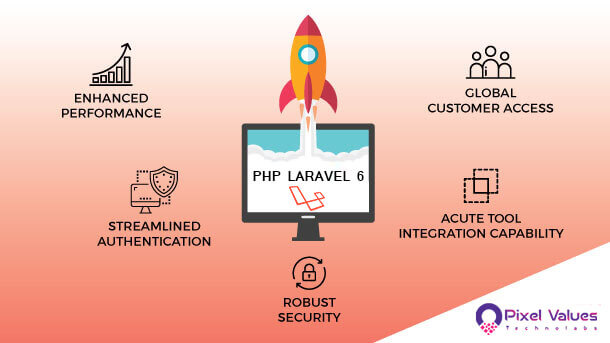
Introduction Of PHP Laravel 6 And What Makes It More Unique To Become #1 Choice Of Web Developers Introduction to PHP According to the global research, “The market share of PHP laravel framework enjoys the highest virtue with a whopping 25.85%.” It was first developed by Taylor Otwell in 2011. Soon after its launch, it became the ultimate choice for both developers and end user because of its clean, expressive and flawless syntax. Today Laravel is considered as the most advanced framework of the PHP language. Latest introduction of laravel 6 that has even made Web Application Development more easy compared o he previous versions. I have overall given a breath of fresh air to the developers with the powerful tools in the bag. What is Laravel? Laravel is one of the best, free and open-source PHP Web Development frameworks which are designed to deliver easy accessibility over the web application development or Laravel Application Development. Though Laravel is free and open-source, it doesn’t leave its community developers left alone and in every six months comes with new updates which makes the development faster, smoother, bug free and more robust. Following this ritual of continuous update, Laravel has come up with a new version Laravel 6. The moment Laravel 6 was announced, it gained tremendous popularity. Laravel has the similar design patterns as that of Symfony, and is a potential alternative to the CodeIgniter framework. What is new with Laravel 6? The latest version of the Laravel 6 comes highly feature rich, and it includes features such as: * Ignition: A new and smart error page. * Laravel UI: UI scaffolding logic such as Bootstrap or Vue is extracted in its own Laravel/UI package * Job Middleware: New feature allowing developers to wrap custom logic around the execution of queued jobs * Lazy Collections: New feature leveraging PHP generators to empower you to seamlessly work with very large datasets * Support for Semantic Versioning * Compatibility with Vapor * Improved Authorization Responses Future of PHP PHP is simple, highly scalable and efficient programming language which is successfully available for years now. As PHP is very flexible, it’s easy to write code in it. With the super strong developer community base and availability of continuous updates it is one of the highly preferred enterprise web development languages. Hence, considering the wide acceptance and critical we see a robust future ahead for PHP. Pixel Values Technolabs is one of the top Mobile App Development Company providing Digital Marketing services to the clients worldwide along with the mobile and web app development services. Conclusion: All the high class features of Laravel 6 have made it one of the most loved frameworks. Being open source even PHP provides an extensive community support to its users, which makes it approachable and understandable by all its users. Hence finding PHP Developers to work on this framework is not a big deal. We at Pixel Values Technolabs have skilled and experienced development, which can turn your ideas into reality. Pixel Values Technolabs is one of the top Mobile App Development Company providing Digital Marketing services to the clients worldwide along with the mobile and web app development services. Author Bio: Nimish Gupta is the Director (PMO) at Pixel Values Technolabs,The Best Mobile App Development Company In India. Nimish has over 13 years of experience in the Information Technology & Telecommunication industry. He has done lots of projects for the Government of India. He is very determined to ensure that solutions presented to the clients adopt the right technology and are scalable to adapt to new platform requirements of the ever-growing Information Technology industry. Contact Information: Call us at 0712-6611379 OR 9822367795 Skype: Pixel_values Website: www.pixelvalues.com
Read MoreBLog

Cross-Platform App Development Framework
Cross-Platform App Development Framework Today approximately 2 million apps exist on Google Play and App Store respectively. In this ever-evolving Mobile App Development ecosystem, this number is expected to increase by 180% by 2020.In such a competitive and ever evolving world, no company can risk missing their presence on either platform. The challenge to this is the cost of development, maintenance and up-gradation of the native apps. Hence, to counter these challenges cross-platform app development has emerged as the first choice of businesses so that with single code base the app can be developed for Android and iOS. What is Cross-App Platform Framework? Cross-platform App Development frameworks provide developers with the ability to code only once which runs on multiple platforms, thereby enabling them to release a product/software faster, safer and with better quality. What’s the Difference between Native and Cross-Platform App Development? The Benefits of Cross-Platform App development: Native v/s cross-platform is an eternal altercation which has divided the tech community for years now. However, as it’s a debatable topic, some experts prefer native apps over cross-platform apps, on the other hand, some experts prefer the other way round.Since both these App Development technologies are in a constant state of evolution this topic needs to be revisited from time to time to check which of these options is currently leading the game. Cross-Platform Mobile Development Comparison: Now that we have seen the importance of cross-platform development frameworks, let’s review the available frameworks, which are – Flutter, React Native and Xamarin. Xamarin It’s a cross-platform framework with C# and native platform libraries wrapped in a .NET layer, consisting of three major components: Xamarin Platform, Xamarin Cloud, and Xamarin Insights.Xamarin Platform offers APIs, controls, runtime engines, encryption, authentication, virtual machines, and much more. Xamarin Cloud offers automated testing platform on multiple devices, whereas, Xamarin Insights is a monitoring tool that helps developers in tracking application crashes and exceptions. React Native React Native is an open source mobile development framework allowing developers to develop iOS and Android applications with JavaScript and a handful of native component APIs. The React Native framework implements a selection of native UI components, means the applications will look like native apps and in fact if done correctly, a React Native app is hardly distinguishable from a native app. Scenarios where substantial customization is needed, the advantage of working within React Native’s abstraction layer lessens to the point where in some cases developing the app natively would be more beneficial. Futter Flutter is Google’s mobile app development SDK which comes with a complete framework, widgets, and tools, thus, giving developers an easy way to build and deploy visually impressive, fast processing mobile apps on both Android and iOS App Development platforms, hence, one codebase for both platforms. Flutter uses Dart and a collection of native widgets to create stunning cross platform apps.It’s developed and supported by Google and has already gained a lot of popularity and strong community presence, hence, Flutter is considered the best tool for cross platform mobile development. Mobile application development platforms comparison Now that you’re well equipped with all the information, depending upon your project need you can select the best way to develop cross platform mobile apps in your case. You can choose either Flutter, Xamarin, React Native, or a native mobile app development framework. Author Bio: Tauseef Anwar is the CEO of Pixel Values Technolabs, The Best Mobile App Development Company In India. Tauseef believes in making customer satisfaction as the top most priority and takes care of the Business Development and operations. An entrepreneur by heart, he is always ready to speak a few words or discuss the latest tech especially if it is mobile technology. Contact Information: Call us at 0712-6611379 OR 9822367795 Skype: Pixel_values Website: www.pixelvalues.com
Read More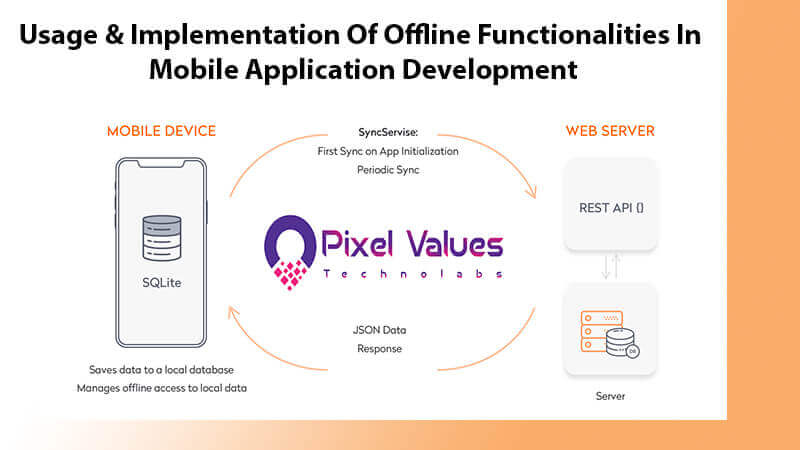
Usage & implementation Of Offline Functionality In Mobile Application Development
Usage & implementation Of Offline Functionality In Mobile Application Development There are more mobile devices in the world than the total number of computers and television units combined. With the rapid adoption of smartphones and tablets, there’s a radical change in the way how the majority of business owners deliver their services or products to clients: they consider mobile apps as a way to the significant improvement of their customer service. We belong to a time where users are dependent on apps in turn; these apps are dependent on internet connectivity for running all functionalities. This dependency of mobile apps on the internet restricts its access and makes it difficult to use in different locations. ‘Offline-first’ is a development approach ensuring that an app works as smooth offline as it does online. Creating an offline-first app, in the right context, ensures a more reliable and faster experience, retaining users and providing a better user experience for your customers. With forward-planning, user-first thinking, and offline-first approach, it’s possible to offer a fast and high-quality user experience “offline”. Making an App work Offline? Most apps require an internet connection, but as they often access the data that doesn’t change frequently, apps don’t really need to be connected to internet all the times. Hence, in such apps, an ‘always-on’ connection to the server is not needed. If an app only has to go to the server when it needs to, rather than all the time, it will be faster and more reliable. ‘Offline-first’ apps make it possible to move content off the server and onto the phone only when needed. Thus, providing fast access to the users and increasing their user experience. An example of the same is any online shopping app which you’re trying to access from a remote poor internet location. In a traditional online app, filling your cart needs the app to go back and forth to the server all the time: because of the poor connection, it’s slow and frustrating. Offline-first moves the content (the shopping app’s directory of products) to the app, thus speeding up the shopping experience. You only need to go online to complete the payment and schedule of the delivery. By moving some of the server-stored content to the app, the whole user experience is faster, smoother and more reliable. Should your app be offline-first? It is a very context specific whether your app should be offline-first. Below mentioned are the three most common reasons for going offlineUsage of your app in areas of poor connectivity: For mobile app development in offline mode, it is important to consider if the app is likely going to be used in areas of poor signal or with limited WiFi connectivity. A happy app without any network hindrance makes the life of a user easier, it is even relevant for users who travel frequently and cannot depend on having a reliable mobile signal. Enterprise-focused productivity apps are one such candidate that can help make our lives a little bit easier and more productive Huge directory of content in your app, accessible via a search function: One cannot depend on slow or unreliable web connection while searching large volumes of online data; it can be time-consuming and can result in a user experience that’s slow and frustrating. This problem is not limited to shopping apps but also affect other mobile game development, utility. To improve your UX in terms of accessibility and speed it is recommended to implement lightweight version of an online database. Your app has limited features and does not require online functionality: It is worth realizing whether your app needs an internet connection for performing its key features. Many applications need go back to internet each time they log a menu option, even ones you consume regularly. Such processes make the app slower and users who want to perform simple operation, in a single transaction this is definitely not helpful for them. As a feasible option data could be downloaded to the app periodically, thus making the UX smoother and fast. Pixel Values Technolabs is one of the top Mobile App Development Company providing Digital Marketing services to the clients worldwide along with the mobile and web app development services. Development of an app offline shows a mobile app design and development challenge but for certain apps gains made in user experience outweighed the costs of offline-first thinking.Not just one, there are many offline apps that made the lives of people simple and easier, success stories even when the internet is absent: Netflix Even in poor connection Netflix started entertaining its users across the globe by allowing its accessibility. As announced, one can download their favorite TV shows and movies on their mobile device using internet and watch them later anytime/anywhere being offline. Google Maps Google Maps a web based service is a best example of offline app which allows users to download pre-set area of their map and then allow them to access detailed maps and directions from anywhere. In case of emergency users can navigate on Google maps without internet connection. Conclusion With offline-first approach no matter what the quality of the internet connection is, the performance of your app will be stable which is indeed the most important for the user experience. Author Bio: Tauseef Anwar is the CEO of Pixel Values Technolabs, The Best Mobile App Development Company In India. Tauseef believes in making customer satisfaction as the top most priority and takes care of the Business Development and operations. An entrepreneur by heart, he is always ready to speak a few words or discuss the latest tech especially if it is mobile technology. Contact Information: Call us at 0712-6611379 OR 9822367795 Skype: Pixel_values Website: www.pixelvalues.com
Read More