
How Custom Product Development Services Help Businesses Scale and Innovate
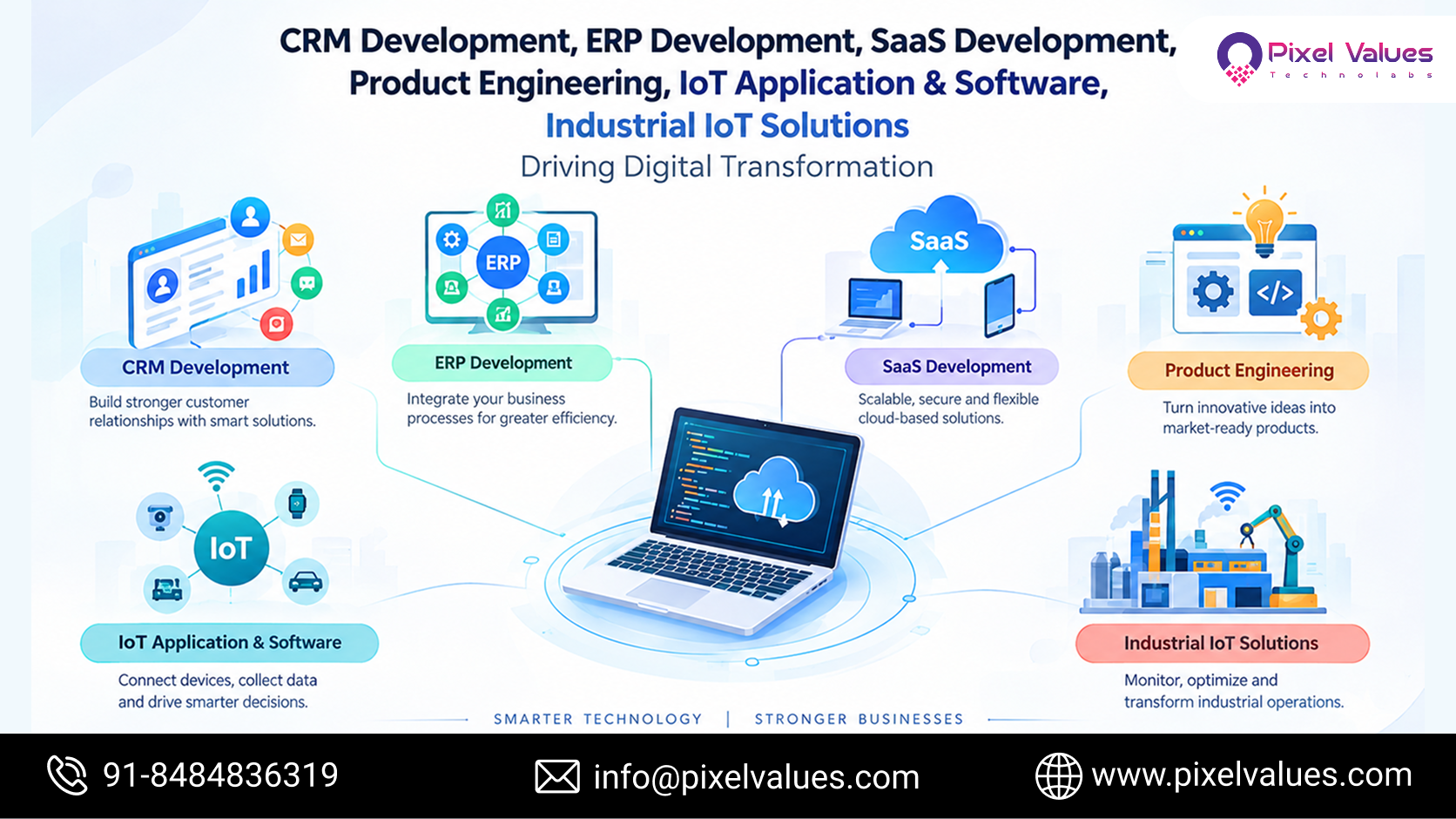
CRM Development , ERP Development, SaaS Development, Product Engineering, IoT Application & Software, and Industrial IoT Solutions are essential technologies that help businesses improve productivity, streamline operations, and remain competitive in an increasingly digital world. Organizations across industries are adopting these solutions to manage customer relationships, optimize internal processes, develop scalable applications, and connect devices for real-time monitoring. Understanding their benefits helps businesses choose the right technology for their operational requirements and long-term goals.
Understanding CRM Development
Customer Relationship Management (CRM) development focuses on creating software that
helps businesses manage customer information, sales activities, marketing campaigns, and
customer support. A customized CRM system allows organizations to organize customer
data, track interactions, monitor sales pipelines, and improve communication across teams.
CRM solutions can automate repetitive tasks, generate performance reports, and provide
insights into customer behavior. Businesses can use this information to strengthen
relationships, improve customer satisfaction, and identify new sales opportunities. A well-
designed CRM platform also supports better coordination between sales, marketing, and
service departments.
The Importance of ERP Development
Enterprise Resource Planning (ERP) development involves building software that integrates essential business functions into one centralized system. These functions may include finance, inventory management, procurement, human resources, production, and supply chain operations.
With ERP software, organizations can reduce data duplication, improve information accuracy, and gain a clearer view of business performance. Instead of managing separate systems for different departments, employees can access relevant information through a unified platform. This integration supports better planning, faster decision-making, and more efficient resource utilization.
How SaaS Development Supports Business Growth
Software as a Service (SaaS) development focuses on creating cloud-based applications that users can access through the internet. SaaS products typically operate through subscription models, allowing businesses to use software without managing all the underlying infrastructure themselves.
Scalability is one of the major advantages of SaaS applications. Businesses can adjust their usage as requirements change, while providers can deliver updates and improvements centrally. Security, user access management, data backup, and system reliability are important considerations when developing a successful SaaS product.
SaaS solutions are widely used for project management, accounting, customer service, collaboration, and business analytics.
Product Engineering for Innovative Solutions
Product Engineering covers the complete process of designing, developing, testing, launching, and improving digital products. It combines technical expertise, user experience design, business analysis, and quality assurance to create solutions that address specific market needs.
Effective product engineering begins with understanding the target audience and defining clear product requirements. Development teams then create prototypes, test functionality, gather feedback, and refine the product. Continuous improvement helps organizations respond to changing customer expectations and emerging technologies.
A structured engineering approach can improve product quality, reduce development risks, and support long-term scalability.
IoT Application & Software: Connecting Devices and Data
IoT Application & Software enables connected devices to collect, exchange, and process information through networks. These applications often combine sensors, communication technologies, cloud platforms, dashboards, and data analytics to provide useful insights.
Businesses can use IoT solutions to monitor equipment, track assets, manage energy consumption, and automate selected processes. For example, connected sensors can report temperature changes or equipment conditions, helping teams identify potential problems before they cause significant disruption.
Reliable connectivity, data privacy, device security, and compatibility are essential when designing effective IoT applications.
Industrial IoT Solutions for Smarter Operations
Industrial IoT Solutions apply connected technologies to manufacturing, logistics, energy, and other industrial environments. By connecting machinery, sensors, and operational systems, businesses can gain real-time visibility into production activities and equipment performance.
Industrial IoT can support predictive maintenance by identifying unusual equipment behavior that may indicate a developing fault. It can also help organizations monitor production efficiency, improve quality control, reduce downtime, and optimize resource consumption.
Successful implementation requires careful planning, secure network architecture, integration with existing industrial systems, and clear performance objectives.
Choosing the Right Digital Development Approach
Selecting suitable technologies depends on business priorities, budget, existing infrastructure, and future growth plans. CRM systems are useful for customer management, while ERP platforms integrate internal operations. SaaS development supports cloud-based products, and product engineering helps transform ideas into market-ready solutions. IoT Application & Software and Industrial IoT Solutions are valuable when connected devices and operational data can improve efficiency.
These technologies can also complement one another. For example, an ERP platform may integrate production information from industrial IoT systems, while a CRM platform can connect customer service data with other business applications. Thoughtful integration creates a more connected digital environment.
Conclusion
CRM Development, ERP Development , SaaS Development, Product Engineering, IoT Application & Software, and Industrial IoT Solutions help organizations modernize operations, improve decision-making, and create better customer experiences. By selecting the right technologies, prioritizing security, and planning for scalability, businesses can build reliable digital capabilities that support sustainable growth. A clear strategy and continuous improvement are essential to gaining lasting value from these solutions.
Author Bio:
Tauseef Anwar is the CEO of Pixel Values Technolabs, The Best Mobile App Development Company In India Tauseef believes in making customer satisfaction the topmost priority and takes care of the Business Development and operations. An entrepreneur by heart, he is always ready to speak a few words or discuss the latest tech especially if it is mobile technology.
Contact Information:
Call us at 0712-6611379 OR 9822367795
Website: www.pixelvalues.com