



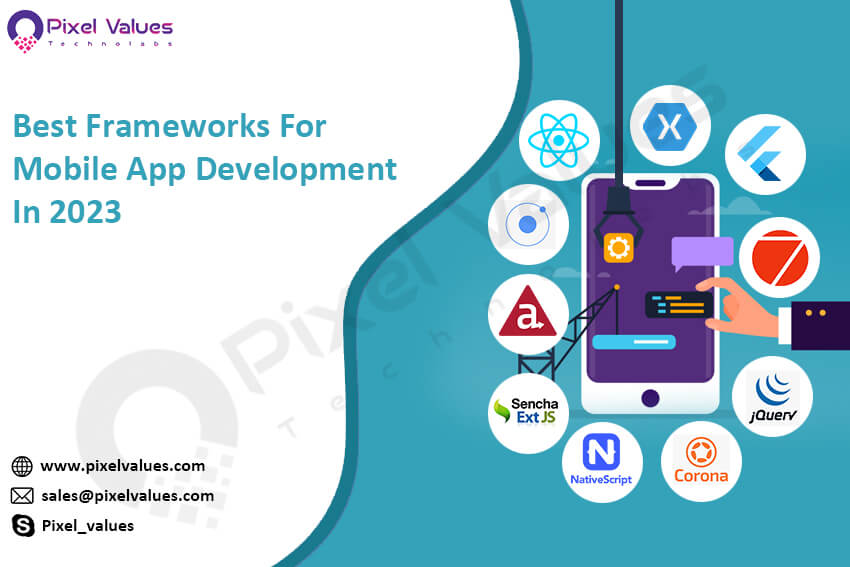
Best Frameworks For Mobile App Development In 2023 The best mobile app development frameworks in 2023 empower developers to build high-performing, cross-platform apps efficiently. Frameworks like Flutter, React Native, and Xamarin offer speed, scalability, and rich UI capabilities. Choosing the right framework ensures faster delivery and enhanced user experiences. I get up every morning using my phone as an alarm, then browse through the notifications, and just before starting for the workplace, I check traffic feeds for a smooth ride. This is a common routine that most of us follow in this app-driven lifestyle and this continues till I sleep… Mobile app development is the key focal point of the apps that are empowering our lives. So today let us know about how and what are these addictive apps made of. Usually an Android App Developer uses Android Studio (the official IDE for app development), Kotlin, and XML, and an iOS App Developer uses Swift (the official IDE). These apps are called Native apps and have the best possible compatibility with their respective OS, but they are a bit costly, and developing them is a bit time consuming process. There are SDKs and Frameworks that can save money and time in the App Development process. You might even know some of the frameworks. But first let us know what is a Framework, before knowing about them. A Framework is a basic structure that is common for all the apps, and also allows the App Developers to focus on the unique selling points of the app. In this way resources and time are saved greatly. Most of these frameworks are based on HTML5, CSS, and JavaScript and you need to know these languages to work on them to create apps. Framework allows you to code once and use it across other platforms like Windows, Mac OS, OS X, Android, and others. Most Used Frameworks In Mobile App Development In 2023 We need an app that could lead us to the charging stations with ease and can make every EV owner’s life tension free from all the upcoming EV changing problems like location, directions, number of charging slots, queue, power shortage, payments & discounts, and many more. The one-stop solution is an EV Charging Station Locator App! * Flutter Flutter is a framework that uses Dart programing language, developed by Google. Initially, it was announced in 2015 and the first alpha version was launched in 2017. Though it is one of the new frameworks, it is quite a popular one yet, because it is used by tech giants like Google, Alibaba, Tencent, and many others. Advantages of Flutter are that it is an open source and free, has cross-platform accessibility, has hot reload feature, has customizable widgets, has native features and APIs deploy ability, and needs minimum coding. * React Native React Native is JavaScript based native app development framework with multi-platform applicability. It was first released in March 2015 by Facebook and it is used by Tesla, Airbnb, Walmart, Instagram, and etc. Advantages of React Native are that it is delivering high performance apps, works across all the platforms, has a large community support, uses single code, and has hot reloading enabled. * Xamarin Xamarin is Microsoft owned Cross-Platform Mobile App Development framework that is powered by C# codebase. It is part of Visual Studio IDE so needs no extra effort for installation. It is opted by many like Alaska Airlines, BBVA, American Cancer Society, and etc. Advantages of Xamarin are that it is free and open source, works across all the platforms, delivers high performance and feel of native apps, has larger community support, and also can work for scalable projects. * Ionic Ionic Framework is the world’s most famous cross-platform app development tool. Millions of apps are made using this framework like McLaren Automotive, Honeyfi, Diesel, and many more are top trending apps made in Ionic. It was made by Drifty Co. in the year 2013, the first beta version was launched in March 2014. Initially, it was only integrated with Angular.Js but is now integrated with Vue.Js and React.Js. It is free and open source. Advantages of Ionic Framework are, it is free and open source, is deployable across all the platforms, is a highly customizable user interface, and has easy documentation. * Framework7 Advantages of Framework7 are that it is free and open source, has extremely fast and high-performance animation UIs, builds fully dynamic apps, works across all the platforms, and allows native features and APIs integration. Advantages of JQuery Mobile Framework are that it is free and open source, is lightweight, has strong community support, and has a larger library of APIs and plugins. * JQuery Mobile Framework JQuery Mobile Framework is built on HTML5 and a lightweight Mobile App Development tool, which allows the developer to design UIs just using HTML5. It was first released in 2006, though it has seen a decline in its use JQuery Mobile is still strong and alive. Advantages of JQuery Mobile Framework are that it is free and open source, is lightweight, has strong community support, and has a larger library of APIs and plugins. * Corona SDK Corona SDK is built on C++/OpenGL, first released in 2009. It has the fastest development speed because it is integrated with Lua (A high level, lightweight, and multi-paradigm programing language). Easy to use and power packed performance made it the most used framework all over the world. Now it is known as Solar2D. Advantages of Corona SDK are that it is free and open source, is delivering lightweight yet powerful apps, works on all the platforms, can deploy native features and APIs, and has very strong community support. * NativeScript NativeScript is built on JavaScript and TypeScript (a superset of JavaScript), first released in 2014 by Progress. Developers across the globe love this framework for its ease of coding and the flexibility that it provides in working with libraries like Angular.Js, Vue.Js, and others. Advantages of NativeScript are that it
Read MoreBLog

Selecting Right Kind Of App Development For Your Business
Selecting Right Kind Of App Development For Your Business The idea of Developing A Successful Mobile App comes with a lot of challenging questions like technology, core objective, design, branding, marketing etc. Answers to these questions play a very important role towards the success of the app, and any wrong decision here could become very expensive. The most expensive ones in the mobile app development are certainly the technical ones. Selecting the right mobile app development platform from the project start can help in many ways however; changing the platform at a later stage in development would undo hundreds of hours of work and exponentially increase the overall costs and slows down the development speed. There are three main mobile app types you can explore for your mobile app development: Native, Hybrid, and Mobile Web apps. All three have their own pros and cons and it’s very important that you select the right one depending upon your requirement. A High Level Difference Between These 3 Mobile App Types Are: Software downloaded from an app store in your smartphone is called a mobile app whereas a web app is an application that can access using a browser on your smartphone and a web app is not downloadable. Native mobile apps are developed for a particular platform or mobile OS to run on like Android Mobile App Development, iOS Mobile App Development or other. There is Hybrid apps which have single code and runs on any smartphone OS. Native Apps: Native apps are single code based apps developed for a specific platform like Android or iOS. In such apps, all the native features of a smartphone can be used like camera, GPS, push notifications, and other features. Application working offline is the most important benefit of Native App Development. Native apps also make a difference in speed, performance and work efficiency. Development and maintenance of the native apps could be little expensive comparatively. Hybrid Apps: As the name indicates, Hybrid applications are a perfect syndication of the best of both the worlds. They leverage the benefits of the native platform, have a feel of the native app, are available of Google Play Store and iOS App Store, and when downloaded they sit on the mobile home screen. Hybrid apps have a common code base for both the platforms and hence, the maintenance cost is also less. React Native, Flutter, and Ionic are the Cross-Platform Mobile App Development frameworks to create a hybrid app. Mobile Web Apps: Mobile web apps can be accessed from the smartphone browser like Chrome, Firefox, and Safari etc. Mobile Web App Development is cost effective since native apps require a platform to run on. Maintenance and hosting of mobile web app is easy and convenient comparatively. Knowledge of JavaScript, HTML and CSS is needed for developing such apps. Mobile web app is compatible with any platform and is independent of OS dependency. Since it’s a mobile web app, you will not see any app icon in your smartphone, you just need to type the URL in the phone browser. Native features like GPS, push notifications cannot be accessed here using a mobile web app. WRAP-UP: The above discussed app types have their own pros and cons and hence, the few key factors to consider before deciding the app development type are: * Business Objective * User experience you want to have * Features complexity * Time to market * App Development and Maintenance Cost While the discussion to differentiate the three mobile apps continues, it’s important to remember that you shouldn’t choose an approach for the technology, but instead, choose based on what you want your app to do. If you choose an approach that doesn’t allow your app to utilize device features, for example, then you’ll end up wasting a lot of time and money when you decide to add features. Once you’ve considered your options and made your decision, it’s of pivotal that you work with Mobile App Developers that can visualize your idea and bring it to life in your budget and according to the core goal of your business. It is important to work with a team that is knowledgeable and experienced in the exact technology that supports your choice so your app can achieve its full potential. Being one of The Best Mobile App Development Company In India, at Pixel Values Technolabs we provide highly experienced and skilled app developers to convert our client’s idea into a successful product. Author Bio: Tauseef Anwar is the CEO of Pixel Values Technolabs, a top-rated Mobile App Development Company. Tauseef believes in making customer satisfaction as the top most priority and takes care of the Business Development and operations. An entrepreneur by heart, he is always ready to speak a few words or discuss the latest tech especially if it is mobile technology. Contact Information: Call us at 0712-6611379 OR 9822367795 Skype: Pixel_values Website: www.pixelvalues.com
Read More