



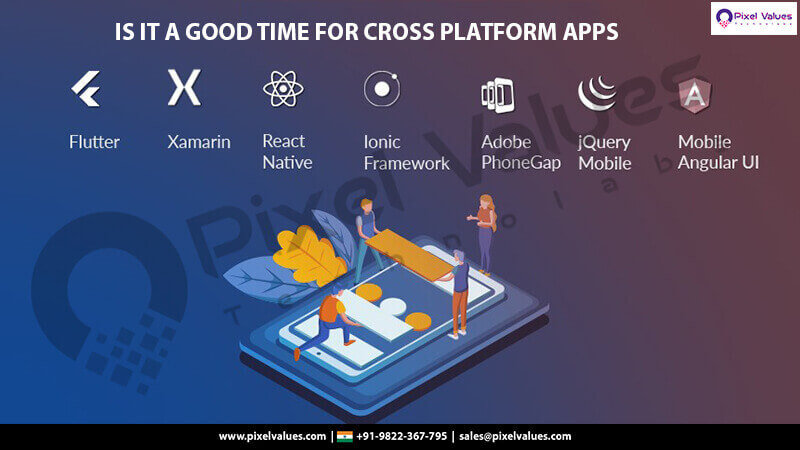
IS IT A GOOD TIME FOR CROSS PLATFORM APPS? With the increasing number of mobile devices and reducing internet usage cost worldwide, the penetration of mobile and mobile apps has increased significantly in last few years. There are close to 5 billion active internet users in the world and more than 50% of the internet traffic is via mobile devices. This number is expected to increase in the coming future as more users will get hooked to the mobile ecosystem. The two major platforms/players which dominate the mobile market are iOS and Android. Combined they both own around 95% of the market share worldwide with almost 3 million apps on each platform. The application developed for one platform cannot run on another platform hence, separate app needs to be developed for both these platforms. But since the competition is very intense between these two platforms, it becomes difficult to choose which platform to target for Mobile App Development. Developing independent app for both the platforms is a time consuming and a costly affair, whereas leaving out any platform could be risk for the success of the app and company profitability. Hence, companies prefer to develop app for both the platforms for maximum customer reach. Technology has helped companies in developing an app using single code base which can run on both the platforms. Thus, reducing the time and cost substantially. Cross-Platform App Development Frameworks has helped companies in achieving the same with minimal cost and high quality. Let’s look at some of the mobile app development frameworks available in the market. PROGRESSIVE WEB APPS Progressive Web Apps (PWA) are web apps with a look and feel of a mobile app. Advantages of developing PWA’s are, these apps do not required to be installed in the device and they load very fast compared to any traditional websites thus offering a seamless user experience. PWA’s offer a very good caching mechanism and hence, they offer a good level of service in the areas where the internet connectivity is very good. There are certain flip sides to all the technologies, and PWA is no exception to it. Some flaws with PWA’s are that they are not compatible with Safari browser, PWA’s cannot access some important phone hardware features like Camera, GPS, and fingerprint scanner. Also, PWA’s consume substantial amount of battery, hence, using them could drain the phone battery fast. NATIVE APPS As mentioned above, Android App Development and iOS App Development are two different platforms. Developing independent apps for these platforms require coding in their respective compatible technology like Java and Kotlin for Android platform, Swift and Objective C for iOS. Such type of apps is called Native apps and offer rich and seamless user experience as compared to hybrid apps. The downside of developing Native app is that the cost of app development and maintenance is very high. CROSS-PLATFORM APPS Cross-Platform App Development are ones which are developed using a single code base and they run very well on both Android Mobile App Development and iOS App Development platforms. Hence, the benefit of Cross-platform framework is that it helps in substantially reducing the cost by having only one cross platform app development team, and as the code base is common, the cost of maintenance is also low. Considering the constraints with PWA’s and high development costs for Native Apps, many companies/developers prefer programming apps in cross-platform framework because of the immense benefit it offers. Due to increasing demand of the cross-platform frameworks, there’s a rise in the number of cross-platforms available in the market and there’s an intense competition in upgrading the existing frameworks for the ease of development. Some popular cross-platform app development frameworks are React Native, Flutter, and Xamarin. BENEFITS OF CROSS-PLATFORM APPS DEVELOPMENT Some of the benefits which Cross-platform apps offer for the businesses are: 1. Lesser Development and Maintenance Cost: As the code base is same, you need only one team to develop the app unlike the native apps where two separate teams are needed. In future if there is any upgrade or bug fixing is required in the app, it needs to be done on a single code, hence the cost of maintenance is also low. 2. Faster Time To Market: As there is only single code base which needs to be developed and maintained, hence, it substantially reduces the development time. Also, if there is any issue which needs to be fixed, it needs to be addressed in only one code base unlike at two different places in case of Native apps. Cross-platform apps reduce the overall development time and decrease the time to market for the businesses thus, giving the competitive advantage. 3. Market Penetration: Cross platform apps have a better market reach as it caters to both Android and iOS platform which together constitutes to `95% of the total market share. CONCLUSION: It’s a very good opportunity for the companies to cash in the opportunity provided by the cross-platform frameworks. Cross-platform companies are investing huge in this framework to bridge the quality gap between Native and Hybrid apps at the earliest. Tech giants like Facebook and Google are the driving forces behind the famous cross-platform frameworks React Native and Flutter respectively, and they try and release a new version every year with it of Mobile App Developer and user-friendly features. The advantages offered by Cross platform app development frameworks is one of the major reasons why there’s a huge influx of apps in the market recently and we expect this wave to continue in the times ahead. The gap between the quality of native and hybrid apps is closing, and it’s closing fast. Huge companies like Facebook and Google are putting their money behind cross-platform app development by launching hybrid app development platforms like React Native and Flutter, respectively. Cross-platform app development is going to take a big leap in 2020 and beyond. New versions of React Native, Flutter, and Xamarin are releasing every year as the companies behind these frameworks are
Read MoreBLog

Developing A Successful Mobile App
Developing A Successful Mobile App iOS and Android Mobile App Development ecosystem is growing at a very fast pace. The reduction in the prices of smartphones and internet, has substantially increased their demand and so does the market for mobile apps. There are close to 5M applications on iOS and Android play store put together, and this application market is expected to reach around $400B by 2026. There are many factors which have contributed to this humongous rise in the mobile apps demand however, the prominent one is the rise in the number of Cross Platform App Development frameworks. Mobile apps help businesses to brand and connect with customers by push notifications, customized offers, and gain insights on customer behavior. To leverage these benefits, many businesses want to build their own apps in this new-age digital economy. Although Android or iOS App Development is a time-consuming process, we are here to help you with the steps involved in a successful app development. 1. Application Objective: Application objective is the actual reason why the application is being developed. It is very important to have a clear objective in mind for making the application so that the team and people involved are focused and aligned in that direction and avoid wasting effort in creating un-necessary features. 2. Feature List: This is the next step after deciding on the Application Objective. Depending upon on the application objective, you decide on the important functionalities you want to have in the application to achieve the objective. Deciding limited but all-important features is important as that will save a lot of un-necessary development time and cost and will also refrain bombarding un-necessary features to the users. 3. Market and Gap Analysis: This is one of the important steps to making a successful application. Market research helps you to understand the good as well as bad offerings by the competition. Good offerings are the ones which you cannot miss to have in your application, and bad/missing features are the opportunities to distinguish your app from the competition. 4.Developing A Wire frame: Wireframes or mockups are rough high-level sketches of your application showcasing the aesthetics and application flow. 5. Technology Selection: Mobile And Web App Development uses many app development frameworks available in the market. There is native – which is platform specific, and hybrid – which is cross-platform way of application development. Depending upon the target audience, app features and budget you need to decide which application framework to be used for a successful mobile application development. 6. Application Development and Testing: This is the actual development stage when the designing and programming of the application is done. The output of the above stages is used to develop the application. The features, technology, objective, wire frames etc. are referred and kept in mind while developing the application. Once developed, the application is thoroughly tested to ensure its bug free and works as expected providing a seamless experience to the users. 7. Application Launch: At this stage you your application is finally ready to be launched into the market. You need to upload your applications in the App store (for iOS apps) and Google Play Store (for Android apps) from where the users download the mobile app. It is always good to plan some marketing activities for the quick success, downloads and acceptability of the app. Digital Marketing, Media Campaign, App Store Optimization are some of the well-known marketing strategies. CONCLUSION: Mobile app development is an expensive, effort intensive and long process. Pixel Values Technolabs, is globally renowned and one of the top-rated Software Development Company having expertise in developing all genres of mobile applications. We help and guide our clients in leveraging our extensive end-to-end mobile app development experience in developing their successful mobile app. Author Bio: Tauseef Anwar is the CEO of Pixel Values Technolabs, The Best Mobile App Development Company In India. Tauseef believes in making customer satisfaction as the top most priority and takes care of the Business Development and operations. An entrepreneur by heart, he is always ready to speak a few words or discuss the latest tech especially if it is mobile technology. Contact Information: Call us at 0712-6611379 OR 9822367795 Skype: Pixel_values Website: www.pixelvalues.com
Read More
Exploring Best Features Of Android 11
Exploring Best Features Of Android 11 Google has launched the third developer preview of its Android 11 version (just to remind the first Android 11 developer preview came in Feb and the second one came in March). Today we’ll explore some of the feature’s Android Mobile App Development has to offer in this developer review 3 and we can expect them in the final stable launch of Android 11. Important note, this is purely a developer preview and not a public beta, hence, it’s only available to download on Pixel phones and to install these updates you need to go through the process of flashing your phone. 1. Native Screen Recording: One of the important and easy to use feature some Android phones already have is the screen recording. In the drop-down setting shade, you see the screen recording option. Tapping this option, you’ll see a confirmation pop-up, selecting this will start the screen recording and will capture whatever you are doing on the phone. You can cancel the recording the anytime. 2. Message Bubbles: Like how Facebook Messenger’s chat heads work, Mobile App Development has also introduced a notification in the form of Floating bubble when you receive a message through the regular messages app. To enable this, just long-press a message notification and tap “show in a bubble”, and now you get your bubbles – any new messages will popup up as a window from this bubble. 3. Redesigned Notifications: One cool new feature in Android 11 is sorting of notifications into relevant groups. Hence, Android App Developers develop an operating system in which conversations will appear at the top in their own easy to read section, making it easier to quickly reply and carry on with your tasks. Adding some extra finesse, there’s also an element of transparency and gradients added to the recent update. 4. Back Gesture Sensitivity: The back gesture could be little annoying at times when it’s used to perform multiple similar tasks. Thankfully, Android 11 empowers you with two sliders, one each on the left and right side of the screen, to control the sensitivity of the ack gesture. 5. Single Time App Permissions: Google has always been known for enhanced security. With Android 11, Google has probably launched the biggest privacy-based feature. Single time app permission lets you tell an app it can only access your location just that one time you’re using the app, rather having to choose between ‘all the time’, ‘only when I’m using it’ or ‘never’. 6. Scheduling Dark Theme: Android 11 is reported to have the ability of scheduling when your device shifts to dark mode. You can either set a custom time or like so many apps and other Android phones you can also choose to have it come on at sunset and switch off at sunrise. 7. Pin Apps To Top Of Share Sheet: Finally, in Android 11 you’ll be able to pin apps and shortcuts to the Share Menu. This feature briefly appeared in the Android 10 build cycle but never made it to final release. But now it’s back and hopefully, this time the feature will remain. Pixel Values Technolabs is one of the top Mobile App Development Company providing Digital Marketing services to the clients worldwide along with the mobile and web app development services. 8. Muting Notifications During Video: I am sure it’s annoying to receive notification when you are capturing a memorable moment with your loved ones. With Android 11, you can mute the notification while recording the videos. Pixel Values Technolabs is one of the top Mobile App Development Company providing Digital Marketing services to the clients worldwide along with the mobile and web app development services. 9. Auto Revoke App Permissions: If you think you are not going to use an app after few months, then you can automatically revoke permissions such as camera, location, and more, from such apps. 10. Undoing Recently Cleared Apps: If you happen to accidentally clear an application, then now you can undo the same by quickly swiping down on the screen. There are many more subtle devices specific and Mobile App Developer focused changes which are published in Android developer review 3. We are expecting that many more features will come-up in the future Developer Previews which will happen between now and the Stable Android 11 launch. SO STAY TUNED!! Author Bio: Tauseef Anwar is the CEO of Pixel Values Technolabs, The Best Mobile App Development Company In India. Tauseef believes in making customer satisfaction as the top most priority and takes care of the Business Development and operations. An entrepreneur by heart, he is always ready to speak a few words or discuss the latest tech especially if it is mobile technology. Contact Information: Call us at 0712-6611379 OR 9822367795 Skype: Pixel_values Website: www.pixelvalues.com
Read More
Embrace Digital Transformation With DevOps
Embrace Digital Transformation With DevOps In the recent years, something which has drawn everyone’s attention in Mobile App Development Company is DevOps. It’s a latest buzzword in the industry, however very few people know what exactly it is all about and have really excelled in implementing it. Successful implementation of DevOps means giving a leading edge to the organization in terms of competition, quality, market readiness, optimizing process etc. Today, in this blog, we’ll try to briefly describe what DevOps is. Mobile apps help businesses to brand and connect with customers by push notifications, customized offers, and gain insights on customer behavior. To leverage these benefits, many businesses want to build their own apps in this new-age digital economy. Although Android or iOS App Development is a time-consuming process, we are here to help you with the steps involved in a successful app development. DevOps is a culture in an IT industry that seeks to promote the collaboration between development and operation teams, which traditionally used to work in silos and create multiple problems in the project due to lack of communication and combined ownership. By removing these silos between different IT teams, DevOps proposes to improve the situation by adopting a product-centric approach that emphasizes automation and tooling to speed up, and make safer, the mechanical tasks of testing and deploying software. Above we have understood the ‘’why’’ of DevOps, now we’ll see ‘’who’’ all is involved in this. There are mainly 3 teams which are involved in any IT project, these are, the development team, QA team and the Operations team. Prior to the concept of DevOps, often these teams used to work in silos as none of them knew each other, and the coordination between them was virtually non-existent. Development team writes the code/module and then send it to the QA team for bugs identification, who in return send it back to the development team with defects to be fixed. At this point, the blame game starts between these 2 teams. Finally, after much deliberation, the module/code once approved by the earlier teams goes to the operations team, who has their own set of problems to handle. The friction between these teams unnecessarily stretches the development cycle, thus impacting the time to market of the product. At this point, DevOps helps in establishing a common understanding & communication between the Web Application Development Services cross functional teams right from the start of the project thus, nipping issues in the bud. Benefits Of DevOps: 1. Faster Time To Market: DevOps help in faster time to market for any software release. This also helps in improving the ROI and reduce the development costs. 2. Transparent: DevOps helps in establishing an early and better communication better communication channel/process between various teams, hence, leading to better transparency among the teams. 3. Early Error Detection: When teams are involved from the initial stage, you get the wholistic perspective of the project. Hence, understanding and foreseeing the issues at the initial stages is possible. 4. Continuous Release: Agile development requires continuous release of the software/app. DevOps helps in achieving this objective as teams are working in close collaboration in this setup. 5. Better Employee Engagement: With more interaction and better communication across teams, employees are happier, which ultimately increases their productivity. The Various Phases of DevOps Lifecycle Are: 1. Planning And Coding As the name suggest, planning of the features that needs to be included is discussed in detail in this planning phase. Once the planning is over, development is initiated which could be in any programming language. 2. Integration And Testing In this phase, continuous integration and continuous testing is carried out. Developer updates the changes the code in the standard directory which is shared with the testers. The Quality Assurance team then tests this code and provide continuous feedback to the developer. 3. Delivery This phase ensures that the code is always ready for release. Continuous delivery ensures that at any point in time, the code is in a state to be released successfully. 4. Monitoring And Feedback The entire process is closely monitored, and continuous feedback is provided to the respective team(s), so that the correction is done at the initial stages only, and no surprises are there in the last moment. Important Tools used in DevOps are: 1. Source code repository 2. Build server 3. Configuration management 4. Test Automation CONCLUSION: DevOps is changing the way we work with iPhone App Development and Android Mobile App Development thus giving development team an edge by using smart and automated processes to produce the best possible application. Now as the teams are coming together, the process is much faster and much more accurate that standardizes coding, testing, and other activities so that the final product contains secure, efficient, robust, and reliable code. Author Bio: Tauseef Anwar is the CEO of Pixel Values Technolabs, The Best Mobile App Development Company In India. Tauseef believes in making customer satisfaction as the top most priority and takes care of the Business Development and operations. An entrepreneur by heart, he is always ready to speak a few words or discuss the latest tech especially if it is mobile technology. Contact Information: Call us at 0712-6611379 OR 9822367795 Skype: Pixel_values Website: www.pixelvalues.com
Read More
Healthcare Sector Will Reach New Heights With The Inclusion Of Voice Assistants
Healthcare Sector Will Reach New Heights With The Inclusion Of Voice Assistants In one of our earlier blogs we informed you about Voice Based Search Is Going To Be A Big Part Of Our Lives In Future. Today, in this blog, we’ll tell you how Voice based assistants are helping the healthcare sector in achieving the new heights, providing convenience to doctors and patients, quick turnaround, reduced cost etc. etc. With well researched algorithms and strong artificial intelligence quotient in place, voice assistants very well understand the users need and give suitable suggestions. Voice assistants are a humane way to interact with machines; it’ll improve patient’s interaction with doctor as the machine will be the apt ally in providing to the point medication. The ever-evolving and recession proof health care sector is worth multi-billion dollar worldwide, and definitely, voice assistants will be the revolutionizing future technology on which the sector will bank on. 1. Better Medical Consultation With voice assistance in place, entire date from diagnosis to the treatment can be stored in voice devices. Periodic reminders can be set and cumbersome paperwork can be avoided. This will help doctors and nurses focus more on patients and give them more time for consultation. 2. Diagnostic Suggestions With combination of Machine Learning, Artificial intelligence, IoT Application Development and Emotional Intelligence, voice assistants can play a role of virtual doctor with whom the patients can have a detailed conversation on their medical needs. Basis discussion, the Voice assistant will use emotional intelligence along with inbuilt AI and ML, and offer correct suggestions to help patients in the treatment. 3. Sharing The Workload With the dearth of quality staff in healthcare sector all around the world, the amount of work load just keeps on increasing. Voice assistant can help patients at least with the initial diagnosis immediately and thus saves a lot of quality time of the patients and doctors. 4. Enhanced Safety Children’s require special care as diagnosing them could transmit germs from doctors, nurse or hospital environment. With Voice Assistants, there will be no human contact and minimal chances of bacteria getting transferred. 5. Helping Patients In Managing Diabetes Based on the patient’s preference, Sugarpod is a type 2 diabetes management solution that has custom tasks for patients. The experience of the patient is usually delivered via SMS, email, web, or via a voice interface. Integrating Sugarpod with voice assistants like Alexa enables patients to manage and monitor their treatments. 6. Assuring Medicine Adherence For Patients Forgetting to take medicine on time is one of the major and most common issues observed in patients. Voice Assistants help people in setting the reminder and ensure patients take their medication on time. 7. Insurance Purchase And Claim Management Selecting the right healthcare insurance plan is a difficult task for many people. To simplify this, Liberty Mutual, an American insurer has developed an Alexa Skill that allows the user to navigate through different insurance plans and helps in managing the policy using Amazon Echo. The Mobile App Development solution also ensures that in case the voice assistant fails to find a policy as needed by the user, it directs the call to an independent agent. 8. Health tips for better life-style Allowing users to take advantage of its vast knowledge base that the academic medical center delivers, Cleveland clinic has Android App Development & iOS App Development with an Alexa Skill. This voice assistant helps user with day-to-day tips for a healthy lifestyle.There is many more use cases of voice assistants in healthcare sector, the ones mentioned above are just surface of it. With expertise from innovative players like Amazon skill development, Google etc. the voice assistant devices will set a new dawn of hope and better treatment facilities in the healthcare sector. Undoubtedly, Voice assistants are the future of the healthcare sector, and its inclusion will bring a revolution of unprecedented and never seen before medical aids for the patients. Author Bio: Tauseef Anwar is the CEO of Pixel Values Technolabs, The Best Mobile App Development Company In India. Tauseef believes in making customer satisfaction as the top most priority and takes care of the Business Development and operations. An entrepreneur by heart, he is always ready to speak a few words or discuss the latest tech especially if it is mobile technology. Contact Information: Call us at 0712-6611379 OR 9822367795 Skype: Pixel_values Website: www.pixelvalues.com
Read More
Choosing The Correct Technology For Your Enterprise Mobile Application Development
Developing A Successful Mobile App iOS and Android Mobile App Development ecosystem is growing at a very fast pace. The reduction in the prices of smartphones and internet, has substantially increased their demand and so does the market for mobile apps. There are close to 5M applications on iOS and Android play store put together, and this application market is expected to reach around $400B by 2026. There are many factors which have contributed to this humongous rise in the mobile apps demand however, the prominent one is the rise in the number of Cross Platform App Development frameworks. Mobile apps help businesses to brand and connect with customers by push notifications, customized offers, and gain insights on customer behavior. To leverage these benefits, many businesses want to build their own apps in this new-age digital economy. Although Android or iOS App Development is a time-consuming process, we are here to help you with the steps involved in a successful app development. 1. Application Objective: Application objective is the actual reason why the application is being developed. It is very important to have a clear objective in mind for making the application so that the team and people involved are focused and aligned in that direction and avoid wasting effort in creating un-necessary features. 2. Feature List: This is the next step after deciding on the Application Objective. Depending upon on the application objective, you decide on the important functionalities you want to have in the application to achieve the objective. Deciding limited but all-important features is important as that will save a lot of un-necessary development time and cost and will also refrain bombarding un-necessary features to the users. 3. Market and Gap Analysis: This is one of the important steps to making a successful application. Market research helps you to understand the good as well as bad offerings by the competition. Good offerings are the ones which you cannot miss to have in your application, and bad/missing features are the opportunities to distinguish your app from the competition. 4.Developing A Wire frame: Wireframes or mockups are rough high-level sketches of your application showcasing the aesthetics and application flow. 5. Technology Selection: Mobile And Web App Development uses many app development frameworks available in the market. There is native – which is platform specific, and hybrid – which is cross-platform way of application development. Depending upon the target audience, app features and budget you need to decide which application framework to be used for a successful mobile application development. 6. Application Development and Testing: This is the actual development stage when the designing and programming of the application is done. The output of the above stages is used to develop the application. The features, technology, objective, wire frames etc. are referred and kept in mind while developing the application. Once developed, the application is thoroughly tested to ensure its bug free and works as expected providing a seamless experience to the users. 7. Application Launch: At this stage you your application is finally ready to be launched into the market. You need to upload your applications in the App store (for iOS apps) and Google Play Store (for Android apps) from where the users download the mobile app. It is always good to plan some marketing activities for the quick success, downloads and acceptability of the app. Digital Marketing, Media Campaign, App Store Optimization are some of the well-known marketing strategies. CONCLUSION: Mobile app development is an expensive, effort intensive and long process. Pixel Values Technolabs, is globally renowned and one of the top-rated Software Development Company having expertise in developing all genres of mobile applications. We help and guide our clients in leveraging our extensive end-to-end mobile app development experience in developing their successful mobile app. Author Bio: Tauseef Anwar is the CEO of Pixel Values Technolabs, The Best Mobile App Development Company In India. Tauseef believes in making customer satisfaction as the top most priority and takes care of the Business Development and operations. An entrepreneur by heart, he is always ready to speak a few words or discuss the latest tech especially if it is mobile technology. Contact Information: Call us at 0712-6611379 OR 9822367795 Skype: Pixel_values Website: www.pixelvalues.com
Read More
Xamarin Vs Flutter: Best cross-platform application development framework?
Xamarin Vs Flutter: Best cross-platform application development framework? In the last decade, there has been a tremendous growth in the mobile industry especially regarding the Mobile App Development, and this is increasing. According to one of the reports, there are more than 3 billion smartphone users in the world and this number is increasingly rapidly every year. Majority of these smartphone are based on either iOS platform backed by Apple, or Android platform backed by Google. There are number of programming languages which can be used to develop the mobile application in these platforms. Xamarin and Flutter are such cross-platform development frameworks, which can be used to develop a cross-platform application. As these are most trending and growing technologies, we have done a quick comparison of them to help you with the best choice for your next Cross-Platform App Development Framework Overview: Xamarin is one of the leading open source cross-platform development framework which uses C# as the programming language is backed by Microsoft. Xamarin was founded in 2011 and was acquired by Microsoft in 2016, which later made it an open source platform, and now it has become an integral part of the Xamarin Visual Studio IDE. Flutter is also an open source free cross-platform development framework tool which uses Dart as the programming language and is designed by Google to create high performance Android and iOS Mobile Applications. It provides a single code, which is also the case in Xamarin. Technical Architecture: For its iOS and Android platforms, Xamarin uses Mono as it execution environment. In iOS platform, Mono runs along with the Objective-C on UNIX kernel, however, in android it runs along with Android run time on Linux. As its backed by Microsoft, Microsoft has provided a detailed documentation to technical architecture used for Android and iOS in Xamarin.The Dart framework of Flutter uses Skia engine which is bigger in size as it has most of the components inbuilt and hence, usually doesn’t require a bridge to communicate with the native modules. The architecture of Flutter is explained in detailed in GitHub wiki. Overall, Flutter has a better technical architecture in place than Xamarin as it has most of the native components inbuilt in its framework itself. Community Support: Since Xamarin is an old cross-platform framework, it has huge community base all across the world. There’s a huge number of developers who uses Xamarin and hence, it is has a huge community forums to discuss the issues, problems, events, updates etc. Xamarin also actively organizes events like Xamarin development summit to keep its community active and strong. Though Flutter is new, but the growth it is shown is very promising. It actually started gaining developer’s attention only after 2017. Even Flutter is organizing events like meet-ups, conferences and Flutter Live to keep increasing it developer base. Though rapidly growing, Flutter has a developer base which is lot lesser than Xamarin. UI Design: Xamarin uses platform specific native UI components for the platform specific apps using Xamarin.android and Xamarin.iOS. Advantage of this approach is it provides greater amount of flexibility and native like look for the cross-platform apps.Flutter uses two different widgets for each of the platforms, for Android Mobile App Development it uses (Material widgets) and for iOS it uses (Cupertino Widgets). Using Skia graphics library, Flutter creates its own GUI components and hence, doesn’t use any native GU components. Hence, this is more advantageous to the developers for customization.Looking at the current rate of growth, undoubtedly Flutter is the future considering its feature richness and ease to use. The only advantage Xamarin has at this point in time the existing huge developer base and the strong community support, which we are sure Flutter will catch-up with in the coming years. Author Bio: Nimish Gupta is the Director (PMO) at Pixel Values Technolabs, The Best Mobile App Development Company In India. Nimish has over 13 years of experience in the Information Technology & Telecommunication industry. He has done lots of projects for the Government of India. He is very determined to ensure that solutions presented to the clients adopt the right technology and are scalable to adapt to new platform requirements of the ever-growing Information Technology industry. Contact Information: Call us at 0712-6611379 OR 9822367795 Skype: Pixel_values Website: www.pixelvalues.com
Read More